An interest rate arbitrage experiment

Published on February 1, 2016

An interest rate arbitrage experiment

Price-difference arbitrage requires constantly monitoring the spread, which makes it hard for an individual to carry out. Interest-rate arbitrage, on the other hand, is feasible for an individual because interest rates move very slowly. To demonstrate this, I actually carried out an interest-rate arbitrage trade.

Interest-rate arbitrage using the New Zealand dollar

As of February 24, the swap points per 10,000 units were
  • DMM FX … sell (-¥38/day), buy (¥38/day), spread (1.7 sen)
  • Hirose Tsushin … sell (-¥90/day), buy (¥60/day), spread (from 1.4 sen)
and 1 NZ dollar was about ¥78.

If you buy 10,000 units at Hirose Tsushin and sell 10,000 units at DMM FX, the effective fee incurred by the spread is about ¥310 for the round trip. The daily interest-rate difference is ¥22, so if you can hold the position for more than 15 days the balance turns positive, giving an annual yield of 0.51% against the underlying. If you set a leverage target of 10x, you can achieve an annual yield of 5.1%.

Results of the experiment
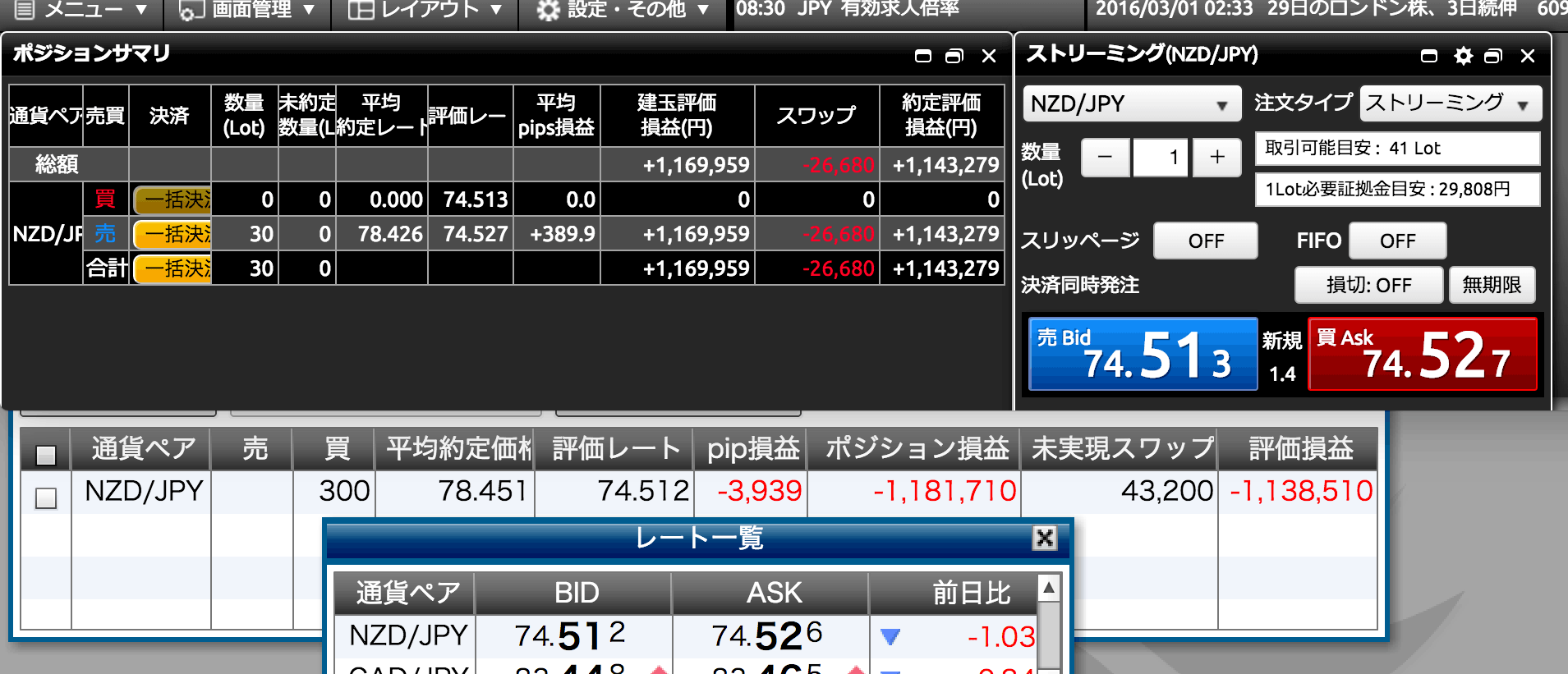
The figure below shows the result of holding a 300,000-unit hedged (both-side) position and earning 24 days' worth of swap. The profit from the swap difference came to ¥16,520 (note 1), which you can see exceeds the ¥12,000 loss from the spread difference (note 2). By continuing to hold this position, you can earn ¥660 per day from the swap difference.
Figure 1: Profit and loss from the interest-rate arbitrage
Note 1 … The swap difference per 10,000 units was ¥18/day at the start of the trade but changed to ¥22/day, so it does not divide evenly by 19.
Note 2 … Because some of the timing was off during trading, the average price difference ended up at 2.5 sen, making the loss larger than the theoretical value of ¥9,300.

Moving the margin

I confirmed that moving money in and out incurs no cost, but since DMM can take up to two business days to process a withdrawal, I found that during unexpectedly sharp swings you may need to prepare temporary funds or settle the position.

Differences in margin calculation

DMM tolerates leverage of up to 50x instantaneously (it checks whether you are within 25x at 22:00), whereas Hirose Tsushin does not tolerate even an instantaneous 25x. Therefore, the lowest-risk strategy is to deposit a little extra margin at Hirose Tsushin and check the difference every night.

The problem of withdrawable balance

When a swing occurs and the leverage on one side grows, you can keep the leverage constant by moving margin to the other side. However, with DMM, profits cannot be treated as margin until the position is settled, so the withdrawable balance is limited to (the amount initially deposited) − (the required margin). With a leverage target of 10x, this created a problem: once the rate moved about 10% from the start, you had to settle part of the position and rebuild it. That said, a 10% swing normally takes about half a year to occur, so you can expect to earn plenty from the interest-rate difference during that time.

Reducing the spread when trading

Because trading all at once tends to cause timing problems, I watched both prices and split the trade into 10 parts, executing each when the difference was as small as possible. This let me build the position at an average difference of about 1.5 sen (minimum 0.6 sen, maximum 2.6 sen), roughly as expected. Settlement can likely be done the same way.